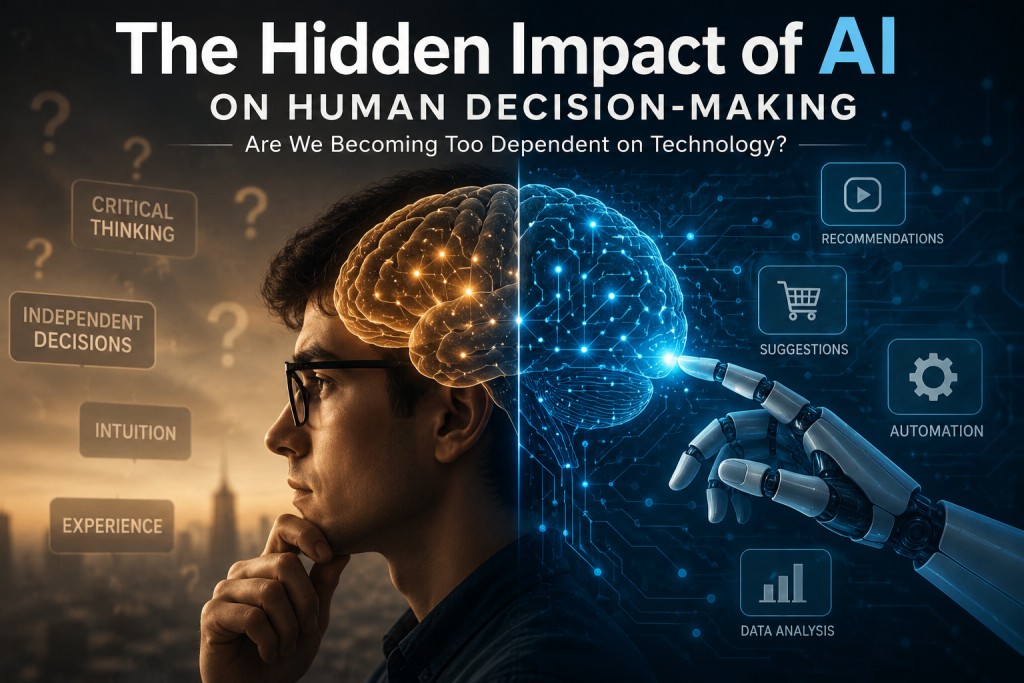

Now Reading: Digital Wellness: What It Is and Why It Matters in the Age of AI
- 01
Digital Wellness: What It Is and Why It Matters in the Age of AI


Think about the first 30 minutes of your morning.
For many of us, the alarm goes off on our phone. We check WhatsApp. Then email. Maybe Instagram or LinkedIn. We read a few headlines, reply to a message, and before we’ve even left the bed, we’ve already spent part of our morning inside the digital world.
Technology has become so deeply connected to everyday life that switching off completely is almost impossible.
We work online. We communicate online. We shop online. We learn online. We entertain ourselves online. And now, with artificial intelligence becoming part of everyday tools, we’re also beginning to think, create, search, and make decisions with the help of AI.
Technology isn’t necessarily the problem.
The real question is whether we are using technology intentionally or simply allowing it to fill every quiet moment of our lives.
That’s where digital wellness becomes important.
Digital wellness is about developing a healthier relationship with technology. It doesn’t mean throwing away your smartphone or disappearing from the internet. It means learning how to use digital tools without allowing them to constantly compete for your attention, time, sleep, focus, and relationships.
And as AI becomes more powerful, that conversation is becoming even more important.
What Is Digital Wellness?
Digital wellness is the practice of using technology in a way that supports your physical health, mental wellbeing, productivity, relationships, and overall quality of life.
You may also hear the term digital wellbeing used for the same idea.
There isn’t one perfect definition because everyone’s digital life is different.
For one person, digital wellness might mean reducing social media use.
For someone working remotely, it might mean creating boundaries between work and personal time.
For a student, it could mean learning how to study online without constantly switching between apps.
For someone using AI every day, it might mean knowing when to use AI for assistance and when to step back and think independently.
The important thing is not simply how much technology you use.
It’s how technology affects your life.
If your phone helps you stay connected with your family, that’s valuable.
If a fitness app motivates you to walk more, that’s valuable.
If AI helps you complete repetitive work and gives you more time for meaningful tasks, that’s valuable.
But if you find yourself checking your phone without knowing why, staying awake because you’re scrolling, or feeling unable to make even simple decisions without asking an AI tool, it’s worth taking a step back.
That’s digital wellness in practice.

Why Digital Wellness Matters in the Age of AI
The conversation around digital wellbeing used to focus mostly on smartphones, social media, and screen time.
AI has added another layer.
Generative AI can write emails, summarize documents, explain complicated subjects, generate ideas, create images, analyze information, and help people solve problems in seconds.
That convenience is remarkable.
But convenience can quietly become dependency.
Imagine asking AI every time you have a question.
You ask it what to write.
You ask it what to buy.
You ask it which option is better.
You ask it how to respond to someone.
You ask it what decision you should make.
Eventually, an interesting thing can happen.
You may stop asking yourself, “What do I think?”
Instead, you start asking, “What does the AI think?”
That distinction matters.
The American Psychological Association has raised concerns about people becoming overly dependent on general-purpose AI tools for mental-health and emotional support, including concerns around critical thinking and the limitations of current AI systems.
This doesn’t mean we should stop using AI.
It means we need to learn how to use it responsibly.
The healthiest relationship with AI is probably somewhere between two extremes: blindly trusting it and refusing to use it at all.
Use it as a tool.
Keep your judgment.
Digital Wellness Doesn’t Mean Becoming Anti-Technology
There is a common misunderstanding about digital wellness.
Some people hear the term and imagine switching off every device, deleting social media, and going completely offline.
That’s not realistic for most people.
Technology has become an important part of modern life.
It allows families to stay connected across countries. Students can access educational resources from almost anywhere. Businesses can work with people across different time zones. People can access information, services, entertainment, and communities that may not have been available to previous generations.
The World Health Organization recognizes that digital environments can offer benefits such as connection, information, learning, and access to services, while also presenting potential risks to mental health and wellbeing.
So digital wellness isn’t about asking:
“How can I use less technology?”
A better question is:
“How can I use technology better?”
That change in mindset is important.
You don’t have to reject technology to live digitally well.
You simply need to make sure technology remains a tool in your life rather than becoming the center of it.
Signs You May Need Better Digital Wellness
You don’t have to spend ten hours a day on your phone to have unhealthy digital habits.
Sometimes the problem isn’t the amount of time.
It’s the feeling that comes with it.
You Check Your Phone Without Thinking
You unlock your phone, look at a few apps, find nothing particularly important, lock it, and then do the same thing again ten minutes later.
If you’ve ever done this, you’re definitely not alone.
You Find It Difficult to Focus
You sit down to complete one task.
Then a notification appears.
You check it.
You open another tab.
You see a message.
You answer it.
You return to your original task and realize you’ve forgotten what you were doing.
Constant digital interruptions can make focused work much harder.
You Feel Uncomfortable Without Your Phone
If leaving your phone in another room for 20 minutes makes you anxious or restless, that is worth noticing.
Your phone should be useful.
It shouldn’t feel like something you cannot be without.
Every Part of Your Day Includes a Screen
You work on a screen.
You eat while watching something.
You relax by scrolling.
You exercise while checking notifications.
You go to bed while looking at your phone.
When there is no longer a clear boundary between online and offline life, digital wellness becomes especially important.
You Scroll More Than You Intend To
You open an app for five minutes.
Forty-five minutes later, you’re still there.
This is one of the simplest signs that your technology habits may not be entirely under your control.
Your Sleep Is Being Affected
You tell yourself you’ll check one more video before bed.
Then another appears.
And another.
Eventually, the five-minute break becomes an hour.
Technology doesn’t always cause sleep problems, but late-night digital habits can certainly make it harder to maintain a healthy bedtime routine.
Digital Wellness vs. Digital Detox
The terms digital wellness and digital detox are closely connected, but they aren’t the same thing.
A digital detox is usually a deliberate break from some form of technology.
It might mean:
- Spending a weekend without social media
- Keeping your phone away during meals
- Having one screen-free evening
- Turning off unnecessary notifications
- Taking a walk without your phone
- Avoiding screens for the first 30 minutes of the morning
A digital detox can give you a useful reset.
But here’s the problem.
You can take a three-day digital detox and then return to exactly the same habits on Monday.
That’s why digital wellness is the bigger goal.
Think about it this way:
A digital detox gives you a break. Digital wellness changes your relationship with technology.
You don’t need to live permanently disconnected.
You need habits that help you stay connected without becoming overwhelmed.
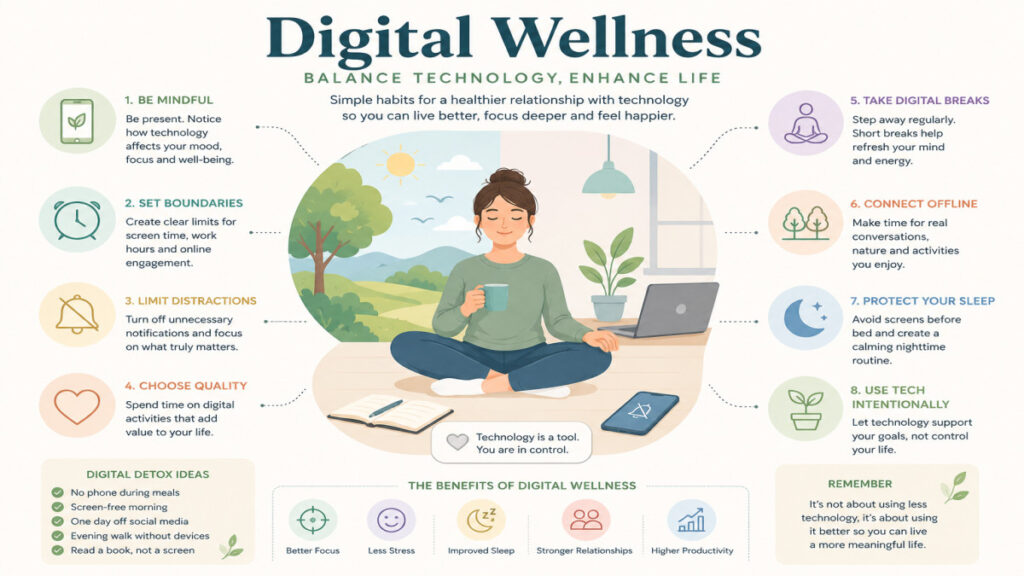
How to Practice Digital Wellness Every Day
You don’t need a complicated system.
Small changes are often easier to maintain than dramatic ones.
Start Your Morning Without Your Phone
Try giving yourself the first 20 or 30 minutes of the day without social media, email, or unnecessary notifications.
Have your tea or coffee.
Take a walk.
Stretch.
Talk with your family.
Think about what you want from the day.
You don’t have to begin every morning by consuming someone else’s content.
Turn Off Unnecessary Notifications
Not every app needs immediate access to your attention.
Ask yourself which notifications genuinely matter.
Keep those.
Turn off the rest.
Your phone should wait for you sometimes.
Keep Your Phone Away During Meals
Try eating one meal each day without your phone.
It’s a small habit, but it creates a clear boundary between eating and digital consumption.
More importantly, it gives you an opportunity to actually be present with the people around you.
Create a Daily Screen-Free Period
Choose 30 minutes or one hour each day when you intentionally step away from screens.
Read a book.
Go outside.
Talk to someone.
Cook something.
Listen to music.
Sit quietly.
It doesn’t have to be productive.
Your mind doesn’t need to be entertained every minute of the day.
Stop Treating Every Notification as an Emergency
An email can wait.
A message can wait.
A social media notification can definitely wait.
Being available every minute of the day doesn’t necessarily make you more productive.
Sometimes it simply makes it harder to concentrate.
How to Use AI Without Losing Your Independence
This could become one of the most important parts of digital wellbeing in the coming years.
AI can be incredibly useful.
The trick is to use it to improve your thinking rather than eliminate your thinking.
For example, instead of asking AI:
“What should I decide?”
Try asking:
“Here are the options I’m considering. What are the advantages, disadvantages, and risks I may be overlooking?”
There’s a big difference.
In the first example, you’re handing over the decision.
In the second, you’re using AI to challenge and expand your thinking.
You can do the same with writing.
Instead of asking AI to create everything from nothing, write down your own ideas first. Then use AI to improve the structure, identify gaps, or make the language clearer.
That keeps you involved in the process.
AI should make you more capable.
It shouldn’t make you feel incapable without it.
And when it comes to mental health, the distinction becomes even more important. AI tools can provide general information or conversational support, but they shouldn’t be treated as replacements for qualified healthcare professionals.
Digital Wellness at Work
Technology has made many workplaces more flexible.
It has also made it easier to stay connected to work all the time.
Think about a typical workday.
Email.
Video meetings.
Slack.
Teams.
Project management platforms.
CRM systems.
AI assistants.
Notifications.
Messages.
And then more messages after work.
Technology was supposed to make work easier.
Sometimes it simply gives us more ways to work.
Healthy digital habits at work can include:
- Checking email at specific times
- Turning off unnecessary notifications
- Protecting focused work periods
- Avoiding meetings that don’t need to exist
- Taking regular breaks from screens
- Separating personal and professional communication
- Using AI to reduce repetitive work
- Setting boundaries after working hours
Being online all day isn’t the same as being productive.
Sometimes productivity means knowing when to disconnect.
Digital Wellness for Families
Digital wellbeing becomes even more important when children and teenagers are involved.
Parents often ask:
“How many hours should my child spend on a screen?”
Screen time is certainly worth considering, but the number alone doesn’t tell the whole story.
Ask a few additional questions.
What is your child doing online?
Who are they interacting with?
What type of content are they consuming?
Are they sleeping properly?
Are they physically active?
Are they spending time with family and friends offline?
Can they put their device away without becoming extremely upset?
The World Health Organization has highlighted both the opportunities and potential risks digital environments can create for young people’s wellbeing.
The goal shouldn’t simply be to remove technology.
Children also need to learn how to use technology responsibly.
That is a life skill they will need as they grow up.
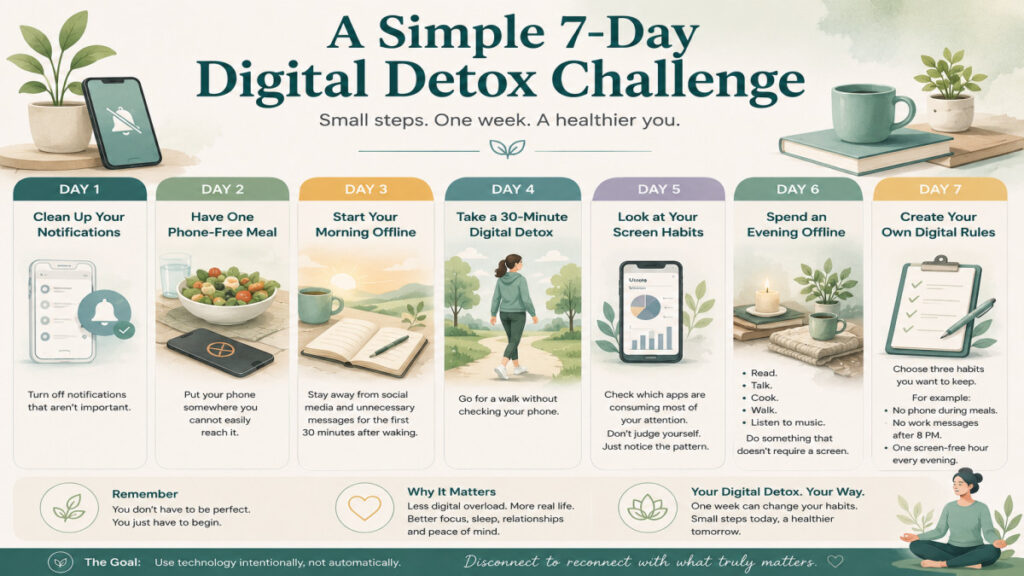
A Simple 7-Day Digital Detox Challenge
If your digital habits feel out of control, don’t try to change everything overnight.
Start with one week.
Day 1: Clean Up Your Notifications
Turn off notifications that aren’t important.
Day 2: Have One Phone-Free Meal
Put your phone somewhere you cannot easily reach it.
Day 3: Start Your Morning Offline
Stay away from social media and unnecessary messages for the first 30 minutes after waking.
Day 4: Take a 30-Minute Digital Detox
Go for a walk without checking your phone.
Day 5: Look at Your Screen Habits
Check which apps are consuming most of your attention.
Don’t judge yourself.
Just notice the pattern.
Day 6: Spend an Evening Offline
Read.
Talk.
Cook.
Walk.
Listen to music.
Do something that doesn’t require a screen.
Day 7: Create Your Own Digital Rules
Choose three habits you want to keep.
For example:
No phone during meals.
No work messages after 8 PM.
One screen-free hour every evening.
That’s enough to begin.
What Will Digital Wellness Look Like in the Future?
The future probably isn’t going to be less technological.
It’s likely to be more technological.
AI will become more deeply integrated into our phones, workplaces, homes, cars, education, healthcare, and everyday decisions.
That makes digital wellness more important, not less.
The interesting possibility is that technology could eventually become part of the solution.
Instead of designing every digital experience around keeping us engaged for as long as possible, future tools could help us recognize when we need a break.
Imagine your device telling you:
“You’ve been working for two hours. Would you like to take a break?”
Or an AI assistant helping you protect a period of uninterrupted focus instead of constantly sending you more notifications.
Research into AI-powered digital wellbeing tools is already exploring how technology might help people develop healthier digital habits, although privacy, ethics, accuracy, and over-reliance remain important considerations.
The technology itself isn’t going to decide whether our digital lives are healthy.
We will.
Final Thoughts: Technology Should Serve Your Life
Digital wellness isn’t about being perfect.
You’ll still spend too long scrolling sometimes.
You’ll still check your phone when you shouldn’t.
You’ll still watch one more video even though you promised yourself you were going to sleep.
That’s human.
The important thing is noticing the pattern and deciding whether it is helping you.
Technology can connect us.
It can educate us.
It can help us work.
It can make difficult tasks easier.
AI can help us explore ideas and solve problems that once took hours.
But none of that means technology should get unlimited access to our attention.
A healthy digital life isn’t necessarily a life without screens.
It’s a life where you decide when technology gets your attention.
That is the heart of digital wellness.
And perhaps the most important rule for the AI era is this:
Use technology to improve your life, not to replace it.
Frequently Asked Questions About Digital Wellness
What is digital wellness?
Digital wellness is the practice of using technology in ways that support your physical health, mental wellbeing, productivity, relationships, and overall quality of life.
What is digital wellbeing?
Digital wellbeing is another commonly used term for maintaining a healthy and intentional relationship with digital technology. It focuses on how technology affects your behavior, attention, health, relationships, and everyday life.
What is a digital detox?
A digital detox is a planned period when you reduce or stop using certain digital devices, apps, or online services. It can last for a few hours, a day, a weekend, or longer.
Is digital wellness the same as reducing screen time?
Not necessarily. Screen time is only one part of the picture. What you do on your devices, why you’re doing it, and how the activity affects your life are also important.
Can AI improve digital wellbeing?
AI may eventually help people develop healthier digital habits through personalized reminders, behavioral insights, and digital wellbeing tools. However, AI should support human judgment rather than replace it.
How can I start practicing digital wellness?
Start with one small change. Turn off unnecessary notifications, create a phone-free meal, keep your phone away during the first part of your morning, or introduce a short digital detox each week.
A Better Way to Live With Technology
Technology isn’t going away.
AI isn’t going away either.
The goal isn’t to escape the digital world.
The goal is to learn how to live in it without losing the things that make life meaningful.
Spend time with people.
Think for yourself.
Go outside.
Sleep without a screen beside you.
Have conversations that don’t involve notifications.
Use AI when it genuinely helps.
Put the phone down when it doesn’t.
That is what it means to live digitally well.
Because technology is a tool.
Your attention is your life.