
Now Reading: The Hidden Impact of AI on Human Thinking: Are We Becoming Too Dependent on Technology?
- 01
The Hidden Impact of AI on Human Thinking: Are We Becoming Too Dependent on Technology?
The Hidden Impact of AI on Human Thinking: Are We Becoming Too Dependent on Technology?

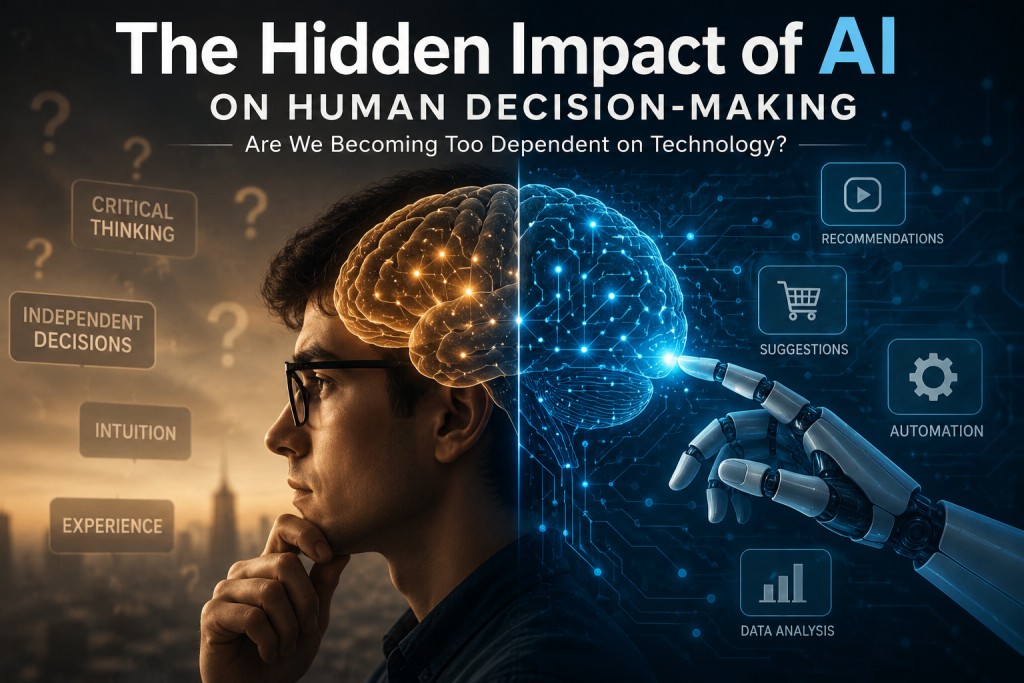
The impact of AI on human thinking is becoming increasingly visible in everyday life. Whether we are choosing a route to work, selecting products online, or consuming content on social media, artificial intelligence is influencing many of our decisions. While AI offers convenience and efficiency, it also raises important questions about critical thinking, creativity, and our growing dependence on technology.
Understanding the Impact of AI on Human Thinking
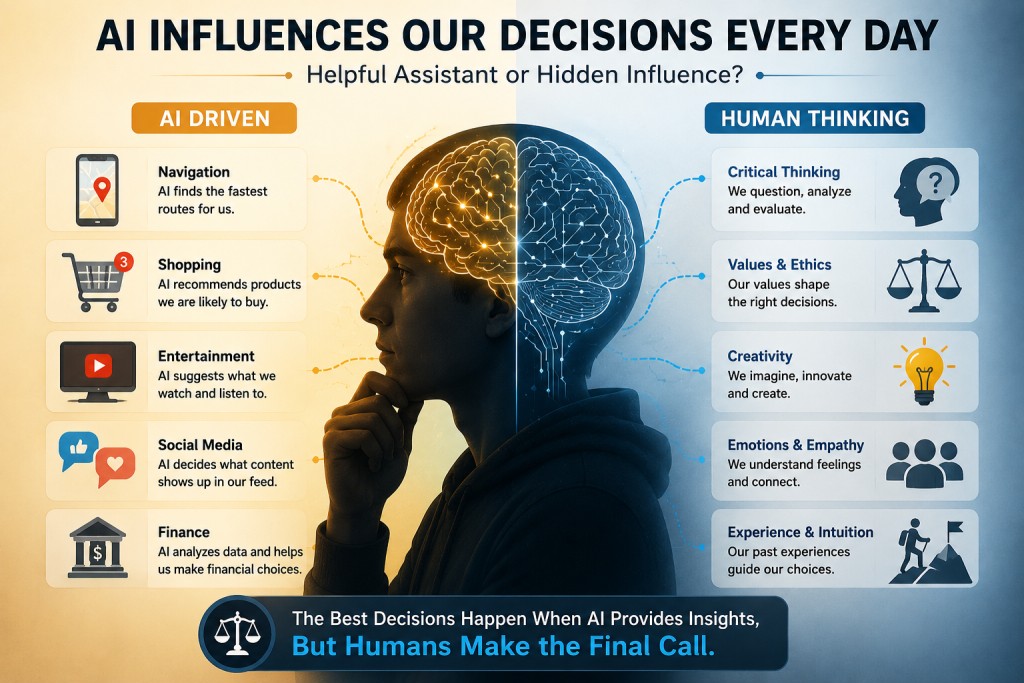
A decade ago, technology mainly helped us perform tasks. Today, it often helps us decide what to do next.
When Google Maps suggests the fastest route, most people follow it without considering alternatives. When an online store recommends a product, we are more likely to purchase it. Social media algorithms decide which news stories, videos, and opinions appear on our screens.
In many cases, AI is no longer simply providing information—it is influencing choices.
While these systems are designed to improve efficiency and user experience, they are also subtly shaping our behavior and decision-making processes.
The Convenience Trap
The growing impact of AI on human thinking can be seen whenever people rely on technology to make choices that they once made independently.
Humans naturally prefer convenience. If a machine can perform a task faster and more accurately, most people will gladly let it.
This isn’t necessarily a problem. In fact, AI has helped businesses become more productive, improved medical diagnostics, and enhanced customer experiences across countless industries.
However, convenience comes with a hidden cost.
The more we rely on technology to make decisions, the less we practice making those decisions ourselves. Over time, our ability to analyze situations critically may begin to weaken.
Think about navigation apps. Many people can no longer navigate familiar areas without GPS assistance. What was once a useful tool has become something many users struggle to function without.
The same pattern is beginning to emerge in other areas of life.
Are We Losing Our Critical Thinking Skills?
One of the biggest concerns surrounding AI is its potential impact on critical thinking.
Critical thinking requires questioning information, evaluating alternatives, identifying biases, and making informed judgments. These skills are developed through practice.
When AI consistently provides instant answers and recommendations, people may become less likely to perform their own analysis.
For example, students increasingly use AI tools to generate summaries, solve problems, and even write assignments. While these tools can support learning, excessive dependence may reduce opportunities to develop independent thinking and problem-solving skills.
The danger isn’t that AI exists. The danger is becoming so comfortable with AI that we stop questioning its outputs.
The Illusion That AI Is Always Right
Many people assume that because AI is powered by advanced algorithms and massive datasets, its recommendations must be accurate.
Unfortunately, that isn’t always true.Understanding the impact of AI on human thinking will help society use technology more responsibly.
AI systems learn from data, and data can be incomplete, outdated, or biased. As a result, AI can make mistakes just as humans do.
There have been cases where AI hiring systems favored certain candidates unfairly, facial recognition technologies misidentified individuals, and recommendation algorithms promoted misleading information.
The difference is that people often trust technology more than they trust their own judgment. This phenomenon, known as automation bias, can lead individuals to accept AI-generated recommendations without sufficient scrutiny.
Blind trust in technology can be just as dangerous as ignoring it altogether.
How Social Media AI Shapes Our Opinions
Social media algorithms are another example of the impact of AI on human thinking, influencing the information and opinions users encounter.
Perhaps the most powerful influence of AI can be seen on social media platforms.
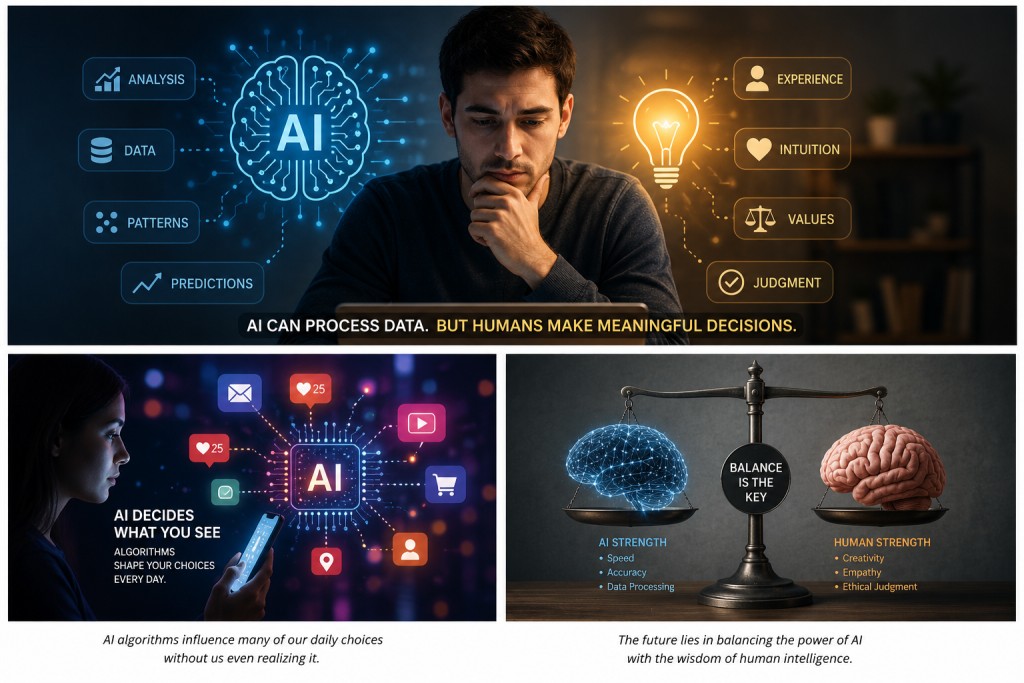
Algorithms are designed to show users content they are most likely to engage with. While this keeps people interested and active, it can also create information bubbles.
Over time, users may be exposed primarily to viewpoints that align with their existing beliefs. This limits exposure to different perspectives and can contribute to polarization.
Many people believe they are independently choosing what to read, watch, and believe. In reality, AI often plays a significant role in determining which information reaches them in the first place.
This subtle influence has profound implications for society, politics, and public discourse.
The Impact on Creativity and Innovation
Creativity thrives on exploration, experimentation, and original thinking.
As AI becomes increasingly capable of generating text, images, music, and even business ideas, there is growing concern that humans may rely too heavily on machine-generated content.
While AI can be an incredible creative assistant, it should not replace human imagination.
Innovation often comes from unexpected insights, emotional experiences, and unique perspectives—qualities that machines cannot truly replicate.
The greatest breakthroughs will likely come from people who use AI as a tool to enhance creativity rather than replace it.
Finding the Right Balance
The goal should not be to reject AI. Artificial Intelligence offers enormous benefits and will continue to transform industries, improve productivity, and solve complex problems.
The challenge is learning how to use AI responsibly.
Researchers continue to study the long-term impact of AI on human thinking and cognitive development.
Instead of allowing technology to make every decision, we should view AI as an advisor rather than an authority.
Before accepting an AI recommendation, ask questions:
- Does this recommendation make sense?
- What information is it based on?
- Are there alternative perspectives?
- Could there be biases involved?
By maintaining curiosity and skepticism, we can enjoy the advantages of AI without surrendering our ability to think independently.
The Future of Human Decision-Making
Artificial Intelligence will continue to become smarter, faster, and more integrated into everyday life. Future generations will likely interact with AI in ways that seem unimaginable today.
But no matter how advanced technology becomes, human qualities such as empathy, ethics, intuition, and critical thinking will remain irreplaceable.
The future should not be about humans competing with AI. It should be about humans working alongside AI while retaining control over the decisions that shape their lives.
Technology can guide us, support us, and empower us. But it should never replace our ability to think for ourselves.
Final Thoughts
AI is changing the way we work, learn, communicate, and make decisions. The benefits are undeniable, but so are the risks.
As we embrace the opportunities that Artificial Intelligence provides, we must also protect the skills that make us uniquely human. Independent thinking, creativity, judgment, and critical analysis are more valuable now than ever before.
The real challenge isn’t whether AI will become smarter. It’s whether we will continue to use our own intelligence wisely as technology evolves around us.
Key Takeaways
- AI is influencing everyday decisions.
- Excessive dependence can reduce critical thinking.
- Human judgment remains essential.
- Responsible AI use requires awareness and oversight.
- The future lies in collaboration between humans and AI.
Frequently Asked Questions (FAQs)
1. How does AI influence human decision-making?
AI influences decision-making by analyzing large amounts of data and providing recommendations based on patterns and predictions. From navigation apps and online shopping suggestions to financial planning and social media feeds, AI helps shape many of the choices we make every day.
2. Is AI making people less intelligent?
AI itself does not make people less intelligent. However, excessive reliance on AI for problem-solving, research, and decision-making may reduce opportunities to practice critical thinking and independent analysis. Like any tool, its impact depends on how it is used.
3. What are the biggest risks of relying too much on AI?
Some of the major risks include:
- Reduced critical thinking skills
- Increased dependency on technology
- Privacy and data security concerns
- Algorithmic bias and unfair outcomes
- Exposure to misinformation and echo chambers
4. Can AI replace human decision-making completely?
No. While AI can process data faster and identify patterns more efficiently than humans, it cannot fully replace human qualities such as empathy, ethics, creativity, intuition, and emotional intelligence. Human oversight remains essential, especially in important decisions.
5. How does AI affect creativity?
AI can support creativity by generating ideas, content, and designs. However, overdependence on AI-generated outputs may discourage original thinking and innovation. The most effective approach is to use AI as a creative assistant rather than a replacement for human imagination.
6. What is automation bias?
Automation bias occurs when people trust recommendations from technology or AI systems more than their own judgment, even when the technology may be incorrect. This can lead to poor decision-making if users fail to critically evaluate AI-generated suggestions.
7. How can we use AI responsibly?
Responsible AI use involves:
- Verifying AI-generated information
- Maintaining critical thinking skills
- Understanding AI limitations
- Protecting personal data
- Keeping humans involved in important decisions
8. Will AI continue to influence our decisions in the future?
Yes. As AI becomes more advanced and integrated into everyday life, its influence on personal, professional, and societal decisions will continue to grow. The key challenge will be balancing AI’s capabilities with human judgment and ethical considerations.
Conclusion
Understanding the impact of AI on human thinking is essential for ensuring that technology enhances human intelligence rather than replacing it.
The impact of AI on human thinking can be observed in education, healthcare, and everyday decision-making.
Artificial Intelligence is transforming the way we make decisions, offering unprecedented speed, convenience, and access to information. From helping us navigate traffic to influencing what we buy, watch, and believe, AI has become an invisible partner in many aspects of modern life.
While these advancements bring tremendous benefits, they also raise important questions about dependency, critical thinking, and personal autonomy. The real challenge is not whether AI will become more powerful—it undoubtedly will. The challenge is ensuring that humans remain thoughtful, informed, and actively engaged in the decision-making process.
AI should be viewed as a powerful tool that enhances human capabilities, not as a substitute for human judgment. By combining the analytical strengths of AI with human creativity, ethics, empathy, and experience, we can create a future where technology empowers us without diminishing our ability to think independently.
As AI continues to evolve, the most valuable skill may not be learning how to use artificial intelligence—but learning when to trust it, when to question it, and when to rely on our own wisdom instead.